# Sentinel S5P - CH4 striping pattern
**URL:** https://forum.atmospherictoolbox.org/t/sentinel-s5p-ch4-striping-pattern/373
**Category:** HARP
**Created:** [July 23, 2021, 4:45am UTC](https://forum.atmospherictoolbox.org/t/sentinel-s5p-ch4-striping-pattern/373 "2021-07-23T04:45:45Z")
**Posts on this page:** 5
**Page:** 1
### Author:  [@DM256](https://forum.atmospherictoolbox.org/u/DM256)
#### Post date: [July 23, 2021, 4:45am UTC](https://forum.atmospherictoolbox.org/t/sentinel-s5p-ch4-striping-pattern/373/1 "2021-07-23T04:45:45Z")
Hello,
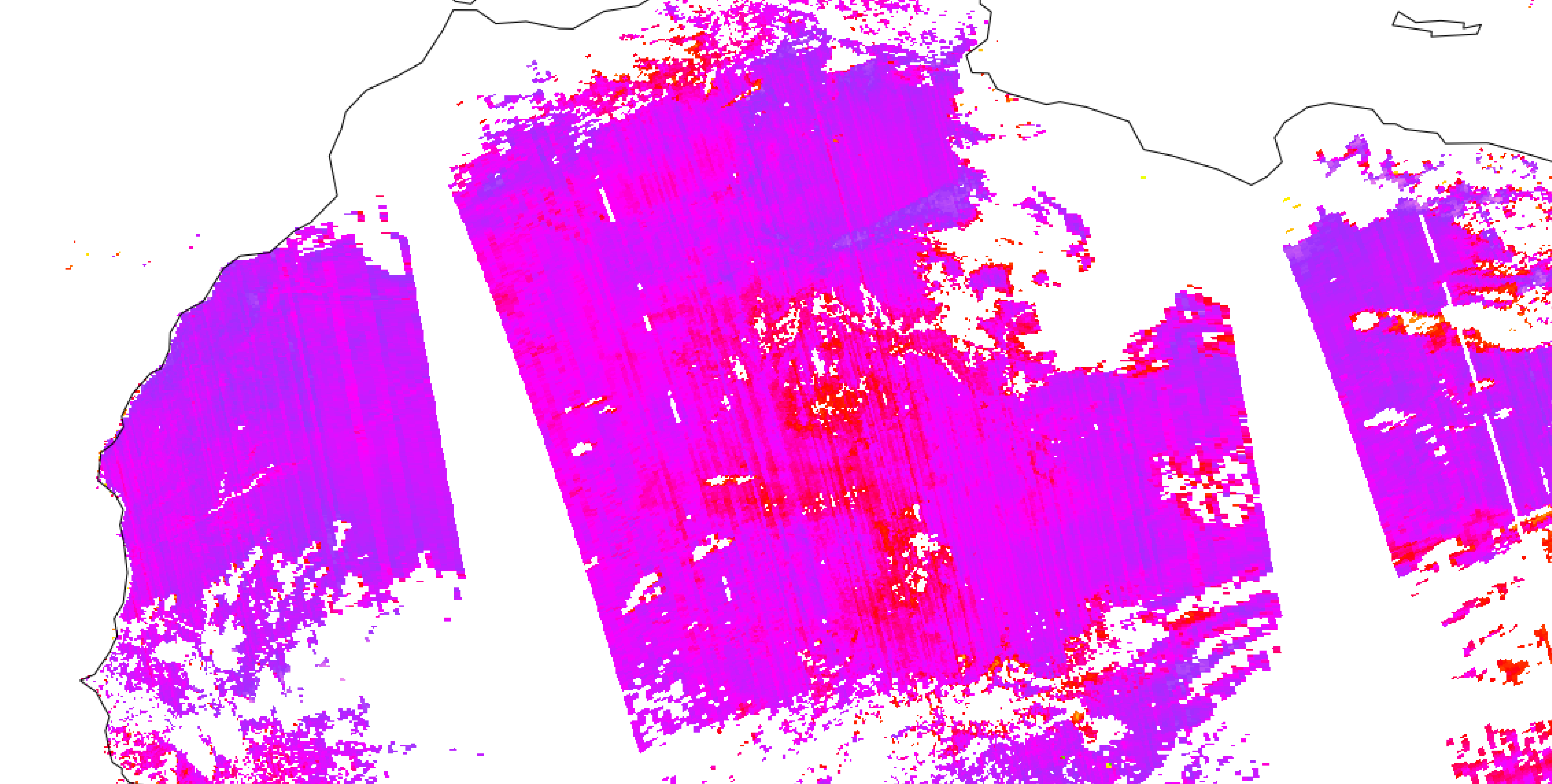
Wondering whether anyone has any experience removing the persistent striping pattern on S5P data? I’ve read in the NO2 PUM that this pattern is identified daily and removed for the NO2 data. Would the provided mask from the NO2 data apply exactly to the CH4 data?
I have looked at other methods to identify the pattern with limited success.
Another question is once the pattern is identified, should the high spots be reduced or the low points amplified?
Here is the stripe pattern over North Africa.
---
### Author:  [@sander.niemeijer](https://forum.atmospherictoolbox.org/u/sander.niemeijer)
#### Post date: [July 26, 2021, 8:19am UTC](https://forum.atmospherictoolbox.org/t/sentinel-s5p-ch4-striping-pattern/373/2 "2021-07-26T08:19:32Z")
For CH4, the product als contains a ‘bias corrected’ version of the CH4 mixing ratios. This does a decent job of removing the stripes.
You can get this data with harp by providing the `ch4=bias_corrected` ingestion option (e.g. add a `options="ch4=bias_corrected"` argument to `harp.import_product`).
---
### Author:  [@DM256](https://forum.atmospherictoolbox.org/u/DM256)
#### Post date: [July 26, 2021, 12:37pm UTC](https://forum.atmospherictoolbox.org/t/sentinel-s5p-ch4-striping-pattern/373/3 "2021-07-26T12:37:22Z")
Thanks again! I see ESA has released a new processor this month and the bias corrected variable in the NetCDF file is present in older files. Will this method work on older data or do we need to wait for a reprocessed dataset?
---
### Author:  [@sander.niemeijer](https://forum.atmospherictoolbox.org/u/sander.niemeijer)
#### Post date: [July 26, 2021, 12:55pm UTC](https://forum.atmospherictoolbox.org/t/sentinel-s5p-ch4-striping-pattern/373/4 "2021-07-26T12:55:30Z")
For CH4 the background corrected value was there already since the beginning. For CO a similar corrected variable was introduced earlier this month.
You can see this back in the mapping description for these products in the HARP documentation. We indicate the processor version if a specific variable/mapping is dependent on the version of the processor.
There will at some point be a reprocessing of the data, since earlier this month they also introduced a new L1b processor version. And the L1b data will likely get reprocessed back to the start of the mission again (including all L2 derived from it). This difference in L1b can be seen in the collection number in the filename. This is 02 for recent products and 01 for older products.
---
### Author:  [@DM256](https://forum.atmospherictoolbox.org/u/DM256)
#### Post date: [July 27, 2021, 12:04pm UTC](https://forum.atmospherictoolbox.org/t/sentinel-s5p-ch4-striping-pattern/373/5 "2021-07-27T12:04:39Z")
Great, looking forward to seeing this bias corrected data. Thanks for the update and help Sander.